

The importance of a reliable eLearning platform has grown significantly in corporate training. With the vast array of options available online, choosing the ideal eLearning platform for corporate training or other educational needs can be daunting.
To make the best choice, it’s important to understand the differences between a Content Management System (CMS), a Learning Content Management System (LCMS), and a Learning Management System (LMS). Each of these has a specific role in the creation, management, and delivery of digital learning content – but understandably, the differences between them may not be immediately obvious.
In this guide, we explore these differences, with a particular focus on LCMS platforms. By highlighting the key benefits and features integral to an LCMS, we intend to streamline your selection process. Furthermore, we will recommend five leading LCMS platforms that stand out in the current market.
Understanding the differences between a CMS, LCMS, and LMS
Although they share similarities, CMSs, LCMSs, and LMSs all have distinct features that significantly influence which platform is best suited for your needs.
CMS
A CMS is essentially software designed to create, manage, and modify digital content on websites. It simplifies the process of content creation, storage, workflow management, and publishing, making it accessible for users with varying technical skills.
A CMS enables website management through features like multiple-user access, SEO-friendly URLs, integrated and online help, and efficient asset management. This system is integral for anyone looking to maintain dynamic websites that require regular content updates.
Popular examples of CMS platforms include WordPress, which is renowned for its flexibility and ease of use.
LCMS
An LCMS is a specialized category of CMS, crafted specifically for e-learning environments. It encompasses tools for content creation, storage, delivery, and tracking of student progress, with a unique capability to repurpose content for diverse audiences.
Unlike a traditional CMS, an LCMS stores content in a central repository, allowing various instructors to adapt and personalize learning materials seamlessly. This focus on digital learning content management makes LCMS platforms ideal for sectors such as corporate training and education, where tailored content delivery is paramount.
LMS
An LMS is a software application dedicated to the administration, documentation, tracking, reporting, and delivery of educational courses or training programs.
The core functions of an LMS include distributing learning materials, monitoring student progress, and evaluating student performance. LMS platforms are particularly beneficial for distance learning, corporate training, and any context requiring internet-based instructional delivery.
While there’s some overlap with CMS and LCMS functionalities, LMSs are distinguished by their comprehensive approach to managing learning experiences.
The benefits of eLearning CMS platforms
The digital transformation of education and training has brought LCMS platforms to the forefront of eLearning.
They have become increasingly relevant for businesses, educators, and course creators, offering a comprehensive solution to author, design, manage, and deliver online courses efficiently. These platforms support a learner-centric approach, enabling personalized and adaptive learning experiences that cater to the individual needs of students.
LCMS platforms are invaluable for their efficiency, allowing for quick course updates, easy repurposing of content, and rapid delivery of courses to learners. Such capabilities save time and also significantly enhance learner engagement.
The cost-effectiveness of LCMS platforms is evident in the return on investment (ROI) they offer. This ROI comes from time savings, increased learner engagement, potential revenue from course sales, and the reduced need for external content creation tools.
By integrating an LCMS into their workflows, businesses, and educational institutions can achieve a seamless, effective eLearning strategy that drives success.
Key features to look for in an LCMS
When selecting an LCMS, certain key features are essential to maximize its benefits.
Organizations can choose an LCMS that meets their current needs and supports future growth and adaptation by prioritizing the following features:
- Intuitive authoring tools: A good LCMS should offer robust authoring tools that support a variety of media, interactive elements, and quizzes. Collaborative course creation features are crucial for developing engaging and varied learning experiences thereby increasing the success of your online learning.
- Mobile accessibility: With learners increasingly consuming content across multiple devices, mobile compatibility is non-negotiable. An LCMS must ensure courses are accessible and optimized for various screens.
- Modular course design: The platform should facilitate the creation of modules with clear learning objectives, tracks, and progress markers, allowing for structured and measurable learning outcomes.
- Integration capabilities: The flexibility to integrate with various tools and platforms adds significant value to an LCMS, enriching your eLearning ecosystem. Compatibility with other enterprise systems such as email marketing platforms or analytics tools, serves as a considerable advantage. Such integrations ensure your training efforts complement broader organizational goals and strategies.
- Security and data privacy: In a digital learning environment encompassing both remote learning and work, robust security measures coupled with a strong commitment to data privacy are crucial to safeguarding the interests of both creators and learners.
- Customization and scalability: An LCMS should offer customization options for branding and personalizing learning experiences. It must also scale to accommodate user growth and course expansion, ensuring the platform evolves with your educational or business needs.
The top 5 eLearning CMS platforms
It’s time to explore the top 5 options currently available in the market. Let’s dive in!
1. Sensei LMS
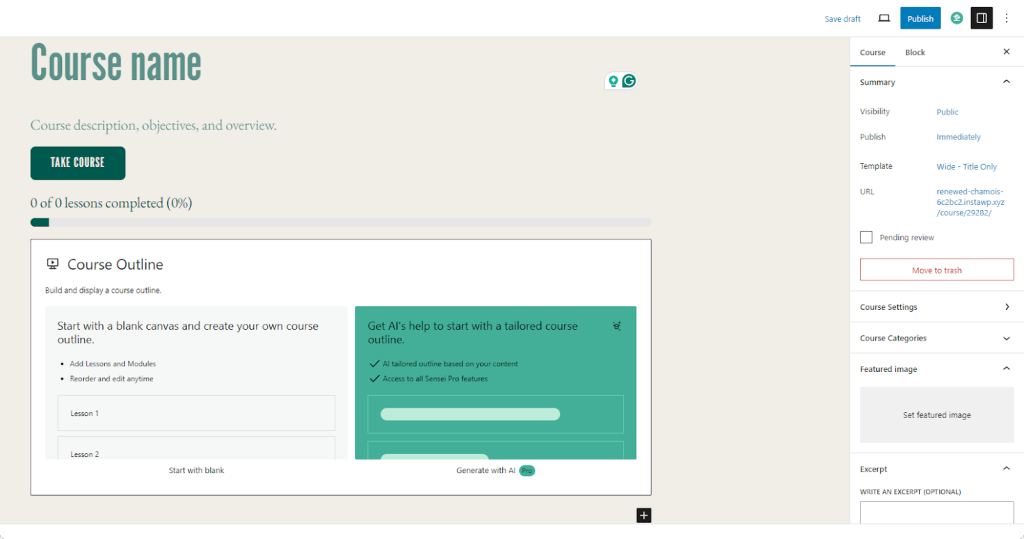
Sensei LMS is a comprehensive solution tailored for eLearning needs, effectively bridging the gap between a CMS, LCMS, and LMS. At its foundation, Sensei LMS is a plugin for WordPress, transforming any WordPress site into a powerful Learning Management System.
Sensei LMS is easy to use with your WordPress site to make, share, and manage courses. You can use Sensei to teach students online, train new employees, or make money by selling courses. It’s flexible, so you can use it in many different ways to help with learning and training.
Different Sensei plans are designed to meet various needs. If you already own a WordPress website and wish to integrate online course capabilities, Sensei Pro is the ideal choice. For those beginning their online course journey from scratch, the Sensei Bundle is recommended. This package includes hosting on WordPress.com, Sensei Pro, and a curated selection of eLearning tools, ensuring you have everything needed to start and manage your online courses effectively.
As an LCMS, Sensei Pro is equipped with features such as interactive blocks and video support for engaging lessons, alongside cutting-edge AI support like AI-generated quizzes to enhance content creation.

Sensei LMS also offers a rich feature set for creating and customizing online courses, content management (including scheduled and drip lessons), and the issuance of digital certificates upon course completion. Its comprehensive capabilities ensure that users can navigate the entire process of setting up and managing online courses efficiently.
Sensei integrates with WooCommerce, so you can sell all your courses. By setting up courses as products, you can use any payment method, including WooPayments, to sell them.
2. EdApp
EdApp is a mobile-first LMS focused on microlearning, designed for delivering engaging, digestible content to learners anytime, anywhere. With features like a library of customizable course templates, gamification, and real-time analytics, EdApp is tailored for organizations looking to implement bite-sized learning strategies.
The platform supports various media formats, enhancing the learning experience. It includes an AI feature for effortless course generation and a SCORM-compliant tool for easy course creation, aiming to boost learners’ knowledge retention through engaging eLearning courses.

EdApp is renowned for its user-friendly interface and innovative approach to learning. However, some users might find the platform’s content creation tools or the variety of features overwhelming, especially if they prefer simpler, more streamlined LMS options without the need for extensive customization or advanced functionalities.
3. Seismic Learning
Seismic Learning, formerly known as Lessonly by Seismic, provides a user-friendly platform for team training and coaching.
The platform equips all customer-facing organizations with the necessary skills, content, tools, and insights to exceed client expectations and drive business growth.
It focuses on ease of use, with drag-and-drop course creation tools, interactive practice scenarios, and analytics to track learner progress. Seismic Learning’s approach is to streamline the training process, making it accessible for teams of all sizes to create custom learning paths.

Seismic Learning specializes in combining training management with tools designed for sales teams. This means it’s particularly good for training staff in customer-facing roles, like sales and service, to improve their skills and effectiveness.
Essentially, it’s a platform that’s great for sales training. However, the platform’s extensive features, blending LMS with sales tools may be challenging for users, potentially leading to a steep learning curve.
4. Itacit
Itacit offers a comprehensive learning and workforce management solution, focusing on sectors with complex compliance and certification requirements.

It combines training management with workforce scheduling, skills tracking, and communication tools. Itacit is particularly adept at handling the nuanced needs of healthcare, construction, and public sector organizations, offering features that support detailed record-keeping and regulatory compliance.
The platform offers complete training solutions that are easily accessible to the entire workforce, ensuring that everyone has the opportunity to engage with and benefit from the educational content.
It is versatile, supporting various formats including SCORM 2004, videos, and PDFs, accommodating a wide range of learning materials and styles. This flexibility allows for the creation of dynamic, multimedia training programs.
5. Auzmor
Auzmor is an all-in-one LMS designed to simplify the delivery of corporate training. It offers features such as automated course assignments, detailed reporting, and an intuitive course builder.

Auzmor’s strength lies in its scalability and ease of integration with HRIS platforms, making it an excellent choice for businesses looking to streamline training and development processes. The platform facilitates training across various departments and sectors, streamlining the education process.
With its extensive course library, teams can be taught swiftly, and the intuitive course builder simplifies the creation of training materials. This design ensures a smooth and efficient training experience for both trainers and learners, catering to diverse organizational needs.
Create the perfect eLearning CMS with Sensei LMS
Exploring eLearning tools, you’ll find LCMS platforms like Sensei Pro are ideal for educators to create and manage content easily. It stands out for its simplicity and ability to make learning more engaging.
When choosing an LCMS, essential features to consider include user-friendly authoring tools, mobile access, and integration with other systems.
Sensei LMS is a leading choice, merging LCMS and LMS capabilities to allow easy creation, management, and sharing of educational materials. Its versatility and ease of use make it a comprehensive solution for anyone looking to build effective training or courses, catering to a broad spectrum of eLearning requirements.
As you explore options to create an eLearning CMS that supports your objectives, consider Sensei LMS as a top contender. Visit Sensei LMS to learn how we can enhance your eLearning initiatives!


